I, like many other people, enjoy finding out more about my so-called self through the act of taking quizzes. There's something oddly comforting in the act of taking a Buzzfeed quiz, even if it reveals some of the most artificial, generalized, and possibly outrageous aspects of a person. I also feel as if this applies to the widely-popular Myers-Briggs Type Indicator, although much more methodical (and somewhat more accurate) in nature.
I'm no stranger to the MBTI, having taken it at least 3-5 times over the past couple of years for a number of reasons. Each time I've taken it my results have come back as ENTP, or what 16Personalities designates as the "Debater." Extroverted? Check. Intuitive? Sounds about right. Thinking? Yes! Perceiving (prospective)? Totally. For the most part, I'd like to think that these tests have been pretty accurate in assessing my personality type. Why would I argue against them after they told me that I was among the ranks of the lovable Jim Halpert and Tom Hanks, the cerebral minds of Thomas Edison and Mythbuster's Adam Savage, and the wacky yet witty Captain Jack Sparrow?
 |
| Once again, how can I argue with this? |
I think that a better model for the understanding of how our identities are shaped is not the nature vs. nurture debate, but instead a compromise: the emerging study of behavioral epigenetics.
As an identical twin myself, I have firsthand experience with the possibility of epigenetics influencing the social and emotional development of my sister and me. My younger brothers are also identical twins, essentially giving me two separate experiences to share and reflect on (yes, two sets of twins in one family...what are the odds?). Given that both sets of us are identical, you'd expect that each set of twins have similar personalities and interests considering that we were born with the same DNA as each other, right? Well, not exactly.
Although neither set of us ended up like the case of Lucky Lyle and Troubled Tim, each of us developed our own identity. My sister is a much more introverted person with interests in mechanics and computer systems, while I ended up being more extroverted with interests in biology and music, among other things. In regard to my brothers, one of them ended up being introverted with more typically-masculine interests such as playing baseball and joining the military, while the other became more extroverted with an interest in the arts. Seeing that we all grew up in the same household, I'm concluding that our identities were formed by factors outside of the home, such as respective groups of friends, extracurriculars, and other social pressures.
This leads me to the idea that there is no "real me," or at least a version of me that is set in stone. If this were the case, my sister and I would have grown up to be the same person. Instead, I believe that my "self" is an ever-changing collection resulting from everything I've been exposed to in my eighteen years of life, along with my own personal motives and morals. Using Baginni's words, I believe that we can "shape, channel, and change" ourselves, depending on the things and people we choose to associate with.
This comment has been removed by the author.
ReplyDeleteAliyah,
ReplyDeleteI definitely agree with you that people like to take these personality tests for a sense of belonging with myself include. It's quite interesting that everyone yearns for some form of identity. I realized that when I was answering the questions, I answered some of them with what I want to be rather how I actually act. How about you? You said that you were always interested in taking Buzzfeed quizzes, so do you believe you were answering the questions based off quiz results you have received in the past?
I also have a sibling and while we are no pair of twins, him and I are extremely close. He is older than me by four years and I always looked up to him. Because of this, I feel as if him and I mostly act the same and have the same interests. I think it is fascinating that your family of twins all have different interests. I know that is a typical archetype for twins though when they are each other's opposites.
Hi Aliyah!
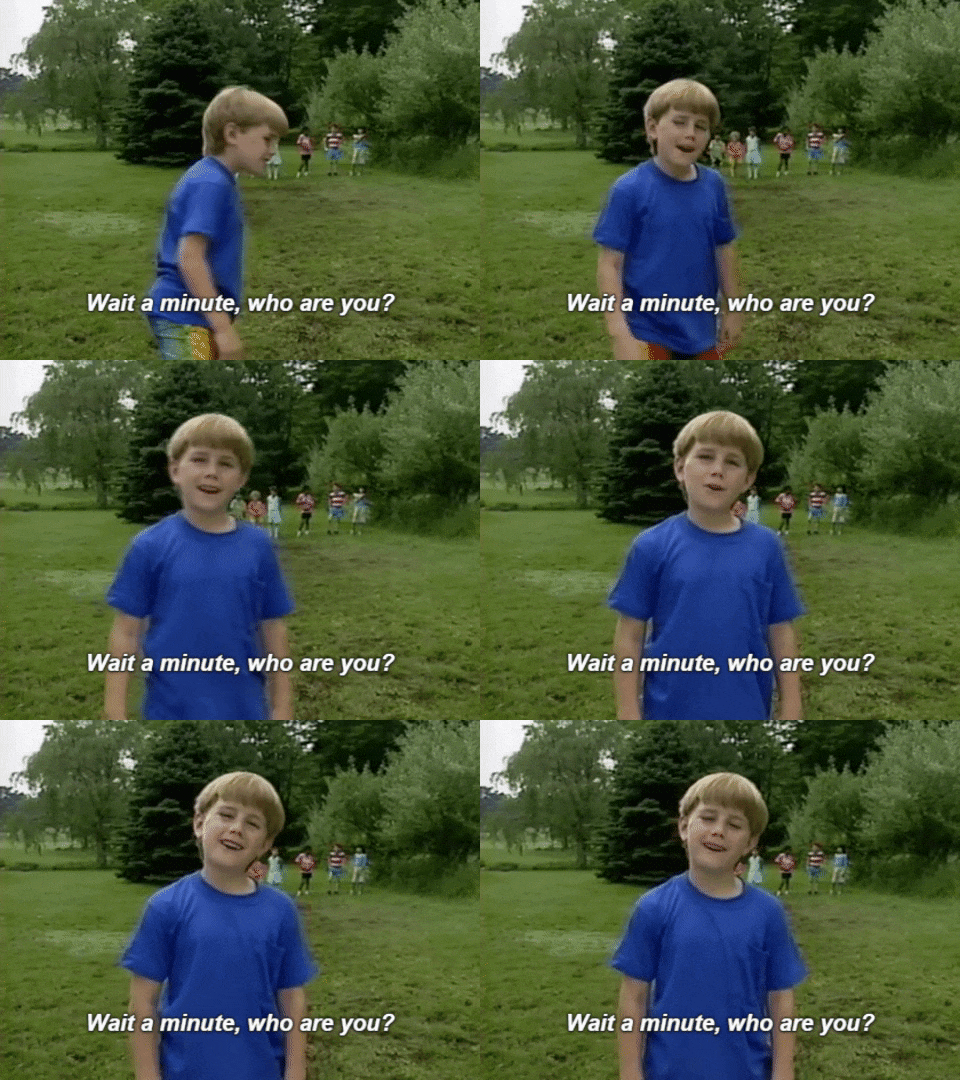
ReplyDeleteThe first thing that drew me in to read your blog post was your meme lol. As I continued to read, I really enjoyed everything you had to say about our identities. One of the most interesting things about your post is the example about your sister and you and your two brothers (that is crazy yet awesome). I think you are completely right about how growing up in the same home and especially essentially 'being the same person,' doesn't mean you are going to be the same. I am a triplet (not identical) but the three of us are completely different with many different interests just the same and you and your family. Of course some things about us are the same, but ultimately we are all different in our own way.
I really enjoyed the video you linked as well because it was very intriguing to see how nurture plays an effect on our nature. I had no idea it could make that much of a change to our DNA. Now that I think about it though, I can very well see how that really does effect people just by examining the people around me. Just like you, I believe that we continue to shape ourselves and grow in many different ways, but I do believe there is a 'real' us because of some traits we exhibit as kids and continue to do so today.
Interesting turn, Aliyah! Good support with the concept of epigenetics and your siblings.
ReplyDelete