 |
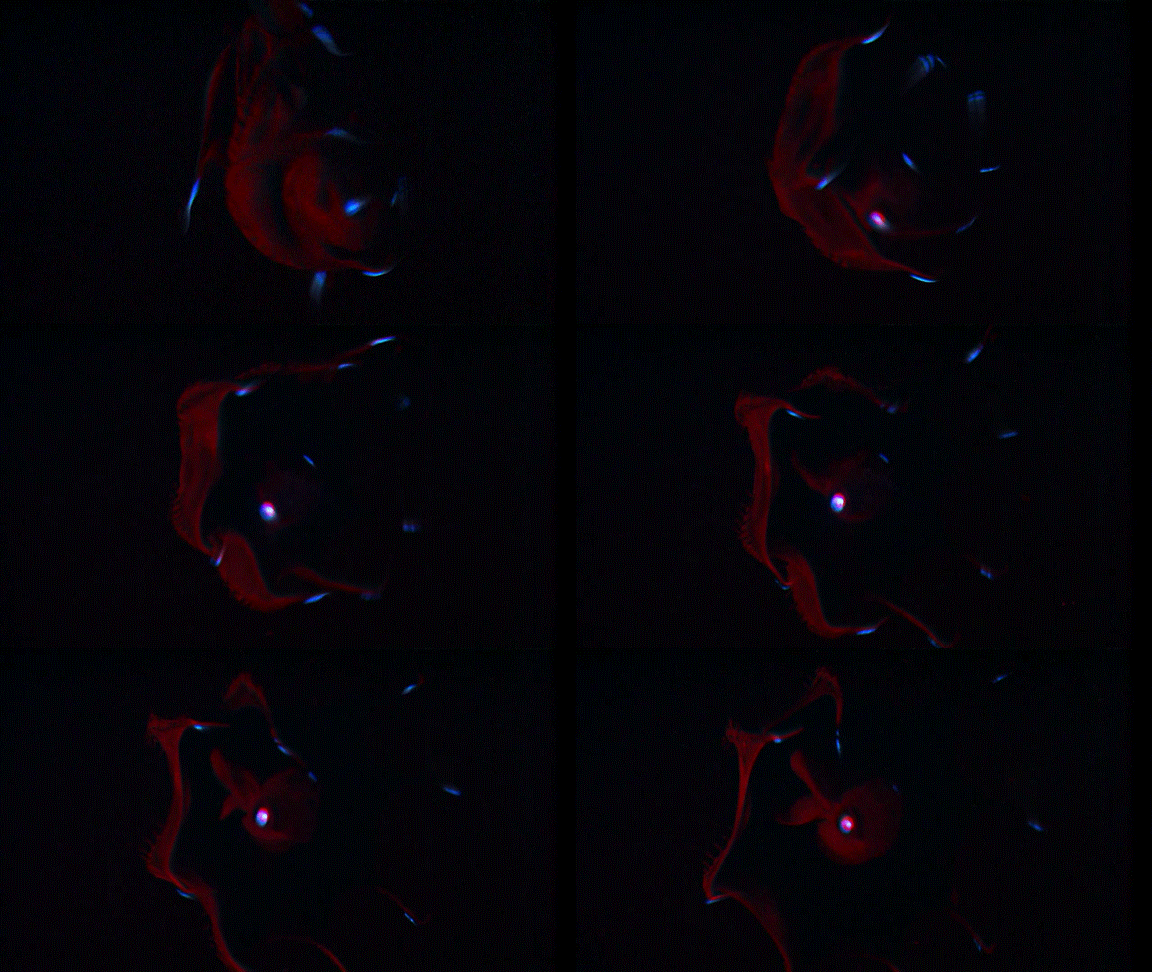
| A vampire squid exhibiting bioluminescent traits. Very cool! |
Part 1
The article I chose discusses the prevalence of bioluminescence in marine species among the different depth levels of the ocean, the causes of the bioluminescence, and how it affects them and their ecosystems. This falls into the category of scholarly articles because it exhibits a number of definitive aspects found in the genre. The first thing that fits the genre's conventions is the title, which is functional and descriptive about what the text is discussing. The second thing that identifies its genre is the structure of which the text was published in. It features an abstract, results section, discussion section, materials and methods, acknowledgments, footnotes, and references. Each section is labeled appropriately with titles for each new piece of information that is introduced. Within these sections, the authors use subsections in order to discuss nuanced topics with more information. The language used throughout the text is very scientific and analytical in nature, yet another feature of scholarly articles. If one were unfamiliar with the biological terms and data reporting used in the article, it might be difficult for them to decipher the meanings of the text's context. The authors do not disclose much information about themselves, other than the fact that they work at the Monterey Bay Aquarium Institute, and which author completed which components of the article, which is found in the footnotes at the end.
This text is written for those interested in the field of marine biology, especially those interested in bioluminescence found in marine species. Like mentioned before, the authors use field-specific text that is heavy in language that typically people with knowledge of biological terms would know. The audience is also expected to know how to interpret certain visuals, such as taxon diagrams, data charts, and topographical maps. The authors do provide supplemental information for each of these graphs in order to ensure understanding of the material presented, however. The discussion section also provides plenty of background information to support their findings, which makes the reported findings much easier to understand.
Part 2
The reason why I chose bioluminescence in marine creatures as my topic is because it is of great interest to me. I've always been intrigued by what lurks in the unknown, especially in relation to the ocean since there is just so much that we haven't explored. The fact that certain species can create their own sources of light is also extremely fascinating to me. I also have a background in biology, so the material and the way its typically presented won't be unfamiliar to me.
For my translation, I would like to complete a short children's book. The idea I would be discussing is the different types of bioluminescent species found at each depth level off of the Pacific Coast, as well as the different qualities of each species/taxon's bioluminescence. As a children's book, this information could be simplified into categorizing them as "families" or single characters. This would potentially help a child identify the species in a way that they could understand, which is one of the goals of children's literature. Instead of designing it as a continuous story, I would give each family/character their own page of content, as it would prevent a child from mixing up the information. In addition to the simplification of the topics, I would also add simple, yet child-like illustrations to help visualize the species.
Hi Aliyah!
ReplyDeleteI think it is so interesting that you are going to do your translation on bioluminescence. This is such an interesting topic to talk about especially since the ride tide just occurred. When you described your article's genre, I completely understood what it was like because you did such a great job explaining it. Just like your article, mine is also a scholarly piece containing many of the same components yours does. I love that you are going to transform this piece into a children's book. Knowing how complex the material is to understand, I think it may be challenging, but fun to see how you can make this information understandable. I think it's important for material to be able to be explained in more of a 'dumbed down' way. I can't wait to see how your project turns out!
I like your idea of doing bioluminescence in marine species. It sounds like a very cool and fun topic to write about. I am not super into marine biology but I do think it is very interesting to learn about. I also wonder what could be down in the depths of the vastly unexplored oceans we have on Earth. Your definition of the genre of the article is pretty spot on from my knowledge. Translating this information into a child's short story is a nice idea. It may be slightly difficult but it would be worthwhile to complete. I believe a good amount of kids would like to read something like that. Especially if the literature has images or illustrations of the marine life within it.
ReplyDelete